
Italian War
Italia – Ethiopian War
The War
Italy disregarded international law and invaded Ethiopia in 1935
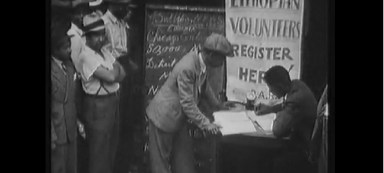
Notwithstanding the tepid response of the League of Nations to the fascist invasion of Ethiopia; Italian imperialism in Ethiopia provoked an outburst of international concern, sympathy, and outright protest from the general public. Private Citizens the world over condemned and denounced Italy’s violation of Ethiopian sovereignty. Although universal in scope, public condemnation of the Italian invasion was particularly sharp amongst the blacks in the United States, who had long drawn inspiration from classical and modern Ethiopia as a symbol of black power and pride.
As a distinguished black historian indicated, “When Italy invaded Ethiopia, They (Afro-Americans) protested with all the means at their command. Almost overnight even the most provincial among the American Negroes became internationally minded.
Change
Ethiopian World Federation Incorporated
Ethiopia was (regarded as) a Negro nation and its destruction would symbolize the final victory of the white man over the Negro.” Many organisations sprung up in Harlem the main area where efforts were concentrated; one example being the Menilek Club formed by public-spirited black citizens in 1936. This very small but spirited group desired to integrate all of the existing Ethiopian Aid societies into one organisation officially recognized by the Ethiopian Authorities. The efforts of the group culminated with a delegation being sent to England in the summer of 1936 to confer directly with Haile Selassie I, who received them at his residence Fairfield House in Bath.
The mission consisted of three prominent Harlem figures, all leaders of the black organisation known as the United Aid for Ethiopia: Reverend William Lloyd Imes, pastor of the prestigious St. James Presbyterian, Philip M. Savoy, chairman of the Victory Insurance Company and co-owner of the New York Amsterdam News, and Mr Cyril M Philp, secretary of the United Aid. The delegation stressed to the monarch the necessity of sending a special emissary to America to direct the collection of all contributions and to help awaken flagging Afro-American support for the Ethiopian cause. Impressed Haile Selassie decided to dispatch an envoy to the United States. He selected his personal physician, Dr. Malaku Emanuel Bayen, for the new position. Later events were to prove that the emperor could not have made a better choice.
“The situation began to change, however as members of the American Communist Party took sharp interest in the United Aid and attempted to transform it into a Communist front.
Wanting to be free of any entanglement with the “Reds,”
whether black or white, Bayen and others decided to form an entirely new organization to be known as the Ethiopian World Federation Incorporated. Consequently, the United Aid was dissolved, a number of similar groups were combined, and a new more substantial organization with Malaku Bayen as its executive head was formally created on August 25, 1937. Dr. Lorenzo H. King, pastor of St. Mark’s Methodist Church in Harlem, was elected the Federation’s first president.
Colonel John Robinson
The Brown Condor
An active member of the Ethiopian World Federation Inc Local Number One, followed by Local 10 Chicago, assisted in the creation of the Ethiopian Air Force/ Ethiopian Airlines
Robinson in Ethiopian Air Force Uniform | |
|---|---|
Nickname(s) | The Brown Condor |
Born | November 26, 1903
Carrabelle, Florida, U.S. |
Died | March 27, 1954 (aged 50) Addis Ababa, Ethiopian Empire (present-day Ethiopia) |
Buried | Gulele Cemetery Addis Ababa, Ethiopia |
Allegiance | United States of America
Ethiopia |
Service/branch | Imperial Ethiopian Air Force |
Years of service | 1935–1944 |
Rank | Colonel |
Unit | Brown Condor Squadron |
Battles/wars | Second Italo-Ethiopian War World War II (East African Campaign) |
Other work | Ethiopian Air Lines |
John Charles Robinson (November 26, 1903[1] – March 27, 1954[2]) was an American aviator and activist who was hailed as the “Brown Condor” for his service in the Imperial Ethiopian Air Force against Fascist Italy. Robinson pushed for equal opportunities for African-Americans during his early career, and was able to open his own eponymous aviation school in addition to initiating a program for black pilots at his college, the Tuskegee Institute. Robinson’s achievements as an aviator were in stark contrast to the limited opportunities for most African-Americans in aviation careers, and were an important factor in reducing racially based prohibitions in the United States. Robinson is sometimes referred to as the “Father of the Tuskegee Airmen” for inspiring this all-black group of pilots who served in the United States Army Air Forces following the United States’ entry into World War II.