

Children whose parents can no longer look after them, and orphaned children live at Awasho Orphanage.
During fact-finding mission children had no meals,
there was no furniture or water, and the children wore 4th hand clothing donated by the community.
As African Americans fixed their gaze on Ethiopia, Abyssinian also travelled to the ‘New World’ and learned of the African presence in the Americas. In 1808 merchants from Abyssinia arrived at New York’s famous Wall Street. While attempting to attend church services at the First Baptist Church of New York, the Abyssinian merchants, along with their African American colleagues, experienced the on-going routine of racial discrimination. As an act of defiance against segregation in a house of worship, African Americans and Abyssinian organized their own church on Worth Street in Lower Manhattan and named it Abyssinia Baptist Church.
Adam Clayton Powell, Sr. served as the first preacher, and new building was later purchased on Waverly Place in the West Village before the church was moved to its current location in Harlem. Scholar Fikru Negash Gebrekidan likewise notes that, along with such literal acts of rebellion, anti-slavery leaders Robert Alexander Young and David Walker published pamphlets entitled Ethiopian Manifesto and Appeal in 1829 in an effort to galvanize blacks to rise against their slave masters.
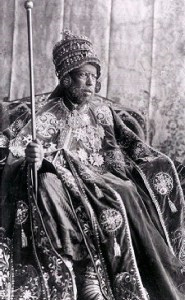 When Italian colonialists encroached on Abyssinian territory and were soundly defeated in the Battle of Adwa on March 1, 1896, it became the first African victory over a European colonial power, and the victories resounded loud and clear among compatriots of the black diaspora. “For the oppressed masses Adwa…would become a cause célèbre,” writes Gebrekidan, “a metaphor for racial pride and anti-colonial defiance, living proof that skin colour or hair texture bore no significance on intellect and character.” Soon, African Americans and blacks from the Caribbean Islands began to make their way to Abyssinia. In 1903, accompanied by Haitian poet and traveller Benito Sylvain, an affluent African American business magnate by the name of William Henry Ellis arrived in Abyssinia to greet and make acquaintances with Emperor Menelik. A Treaty of Amity (Friendship) and Commerce between Emperor Menelik II of Abyssinia and Robert P. Skinner for the United States was signed. Ellis recounts to the emperor the great Emancipation Proclamation of Abraham Lincoln and America’s interest in trade as opposed to colonization. The Treaty is duly proclaimed by U.S. President Theodore Roosevelt.
A prominent physician from the West Indies, Dr. Joseph Vitalien, also journeyed to Abyssinia and eventually became the emperor’ trusted personal physician.
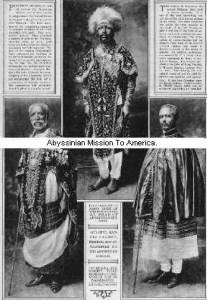
In 1920 Rabbi Arnold Josiah Ford, Harlem’s African American Jewish leader and musical director of the United Negro Improvement Association, composes the song “Ethiopia Awaken” that becomes the anthem for the Ethiopian World Federation.
The announced coronation of Haile Selassie in 1930 as the first black ruler of an African nation in modern times raised the hopes of black people all over the world and led Rabbi Ford to believe that the timing of his Abyssinian colony was providential. The Abyssinia government had been encouraging black people with skills and education to immigrate to Abyssinia for almost a decade, Ford took up this invitation and arrived in Abyssinia with a small musical contingent in time to perform during the coronation festivities.
Mignon Innis arrived with a second delegation in 1931 to work as Ford’s private secretary. She soon became Ford’s wife, and they had two children in Abyssinia.
Ford’s wife, Mignon T. Ford would later establish the Princess Zennebe Worq High School, which was the first secondary school for girls in Abyssinia.
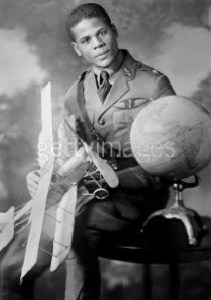 In November 1930, Ras Tafari Makonnen was crowned Emperor of Abyssinia. The event blared on radios, and Harlemites heard and marvelled at the ceremonies of a black king. The emperor’s face glossed the cover of Time Magazine, which remarked on “negro news organs” in America hailing the king “as their own.” African American pilot Hubert Julian, dubbed “The Black Eagle of Harlem,” had visited Abyssinia and attended the coronation. Describing the momentous occasion to Time Magazine, Hubert rhapsodized:
“When I arrived in Ethiopia the King was glad to see me… I took off with a French pilot… We climbed to 5,000 ft. as 50,000 people cheered, and then I jumped out and tugged open my parachute… I floated down to within 40 ft. of the King, who incidentally is the greatest of all modern rulers… He rushed up and pinned the highest medal given in that country on my breast, made me a colonel and the leader of his air force — and here I am!”